Poo Goes There Too
Bo needs a wee, then a poo — and asks your child the answers along the way. Read it together and wait for the shout.
What the story does
Some children happily wee on the toilet but hold on, hide, or refuse when it comes to a poo. Bo's story is built around that specific moment — short, rhyming, and made to be read with a child rather than just to them.
Every page asks a question and waits. Bo offers a few silly wrong answers first — a sock, a boot, the kitchen sink — so there's something to shout NO! at before the real answer comes.
It is deliberately short: one sitting, one seat, no pressure to finish anything except the rhyme.
At a glance
- Ages 2–5
- Rhyming, call-and-response, around two minutes
- 12 pages free online, four shout-along questions — the paperback adds a second story
- Written and illustrated by Simone Fenn
- Notes for grown-ups on this page, with sources
Where does the poo go? In the loo!
Push the handle, hear the flush — whoosh, whoosh, whoosh!
Inside the book
Two stories, one paperback. Free online here, you get story one, “Poo Goes There Too” — Bo's wee-then-poo story at home. The paperback also includes a second story, “Bo Goes to a New Loo”, about finding and using an unfamiliar toilet away from home. The second story is print-only — it isn't on this site.
“Wee goes in the loo. Bo knew!”
“Wee goes in the loo — and poo goes there too!”
“Bo did it! Whee! Bye bye, poo. Wave: one, two, three!”
You can also colour this very story as you read it. Click Read it free above, then tap Colour it in on the toolbar to turn each page into line art to colour on screen or print.
Free colouring book
This story’s scenes are inside “Colour Me In”, a free twelve-page colouring book Bo shares with Squeak. Print it and colour along.
Free to print at home, for childcare or classroom use.
Bring Bo home
A real paperback for the shelf, the car, or bedtime.
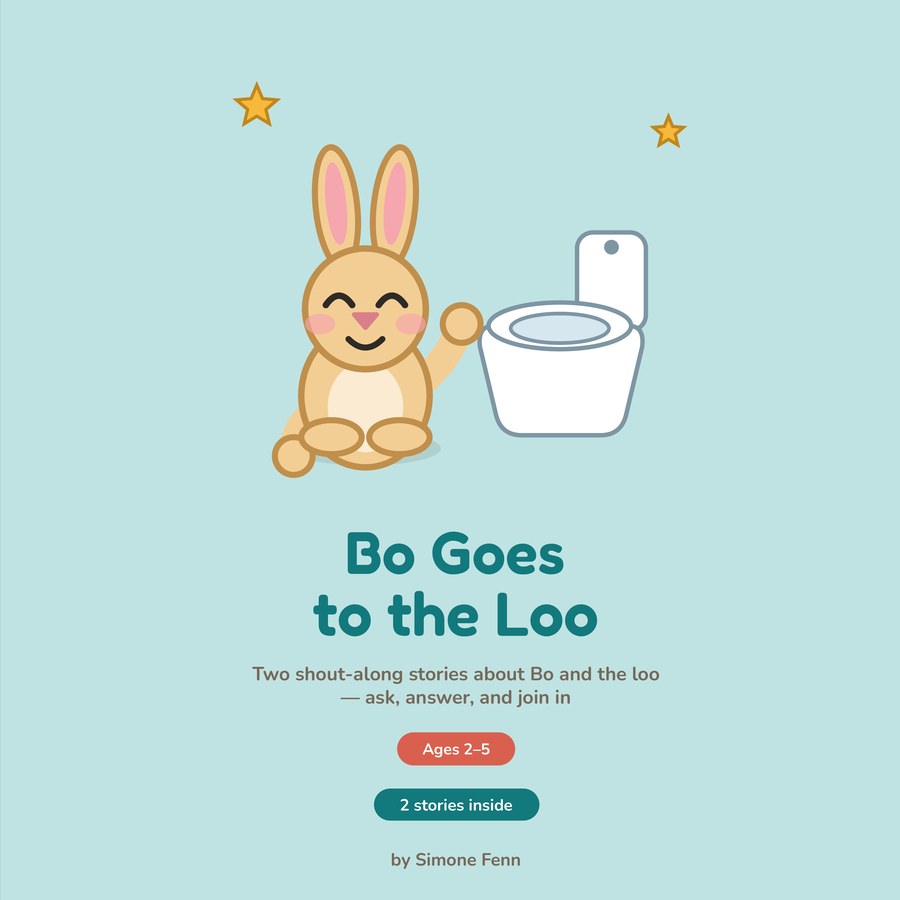
Linked to Amazon.ie — also available on Amazon in other countries; search “Bo Goes to the Loo” on your local Amazon store.
The paperback has two stories: this one, plus the away-from-home follow-up, “Bo Goes to a New Loo”, which is print-only.
For the grown-ups
The thinking behind Bo's story, and where the deeper reading lives.
Why the wrong answers come first
Bo's story is for the specific pattern where a child is happy to wee on the toilet but holds on, hides, or gets upset at the idea of a poo. That pattern — often called stool toileting refusal — is common and well studied, and it is not the same thing as general toilet-training reluctance. [1][2] The silly guesses (a sock, a boot, the kitchen sink) exist so a child gets to shout "NO!" before the real question — giving them a playful, low-stakes way in rather than asking them to sit still and answer a serious question about something that may already feel a bit frightening.
Sitting is the win, not producing
The story ends every time with a flush, because a page needs an ending. Real progress with this pattern is usually slower and comes in stages — sitting on the toilet fully clothed, then sitting with a nappy on over the toilet, then without one — and each stage is worth celebrating on its own, well before a poo is involved. [1]
When it's worth asking a doctor
Withholding often starts after one uncomfortable or painful poo, and constipation is both a common cause and a common result of it — each can feed the other. If your child seems to be in pain, passes hard or infrequent stools, or the withholding has gone on for more than a couple of weeks, it's worth a conversation with your GP, health visitor or public health nurse: it's very treatable, and it's the first thing worth ruling out. [3]
References
- Taubman B. Toilet training and toileting refusal for stool only: a prospective study. Pediatrics. 1997;99(1):54–58. pubmed.ncbi.nlm.nih.gov/8989338
- Blum NJ, Taubman B, Nemeth N. Stool toileting refusal: a prospective intervention targeting parental behavior. Arch Pediatr Adolesc Med. 2004;158(12):1190–1193. pubmed.ncbi.nlm.nih.gov/14662573
- Tabbers MM, DiLorenzo C, Berger MY, et al. Evaluation and treatment of functional constipation in infants and children: evidence-based recommendations from ESPGHAN and NASPGHAN. J Pediatr Gastroenterol Nutr. 2014;58(2):258–274.